
Other Highlights: Turtle Fountain, Marcello Theatre, Portico of Octavia, Casina of Vallati Museum, and Santa Maria in Campitelli Church. Hotel Recommendations: Il Tempio Della Capitale – A minute’s walking distance from the Synagogue of Rome, the hotel offers comfortable accommodation in well-appointed rooms which are fitted with modern. Alto Piemonte is one of the finest wine regions of Italy and some of its crus, like Boca and Gattinara, are situated inside the crater of a fossilized Supervolcano, a Unesco protected geopark.
- Casina Vallati Rome
- Casino Of Vallati Jobs
- Casino Of Vallati Thunder
- Casino Of Vallati Characters
- Casino Of Vallati Numbers
The Jewish Quarter in Rome is a world of its own, an enclave built by the constraints of a dark history. But since it has become an inviting and elegant corner in Rome, attracting both locals and tourists. It is located just off the busy Lungotevere de’ Cenci street running along the Tiber River. The Great Synagogue of Rome, the cultural and symbolic centre of its ancient Jewish community, marks the entrance to, and is one of the focal points of, the neighborhood. Built in the late nineteenth century, it is the largest synagogue of the city, and has withstood multiple attacks.
Old and new blend together seamlessly here, as in so many Roman landscapes. Men and boys in kippahs stroll down the cobblestoned Via del Portico d’Ottavia, flanked by kosher restaurants, food shops, and cafés with al fresco seating. L’Oro di Roma, or the Gold of Rome, the 1961 film by Carlo Lizzani, recounts the dreadful events that took place in the heart of the Jewish ghetto. The street Largo 16 Ottobre 1943 is named in memory of the Raid of the Ghetto of Rome, which saw the deportation of over 1,000 members of the Jewish community to the Auschwitz concentration camp. A plaque on the Vittorio Polacco elementary school reads, in Hebrew and Italian: “In memory of the 112 students whose lives were lost in Nazi extermination camps.” The ancient structure of the Porticus Octaviae, which once enclosed temples of the gods Jupiter and Juno, dates back to Imperial Rome. The open-air Theatre of Marcellus, or Teatro Marcello, a relic of the Roman Republic, stands not too far away. Visitors can walk through the ruins and end up at Via del Teatro di Marcello, which leads to Piazza Venezia and the Vittoriano monument.
Rome’s Holocaust museum foundation, ‘Museo della Shoa,’ has opened the exhibit Vite Spezzate, or Shattered Lives, at the Casina dei Vallati, also located on Via del Portico d’Ottavia, in solemn commemoration of the leggi razziali, or the Italian Racial Laws of 1938. This year marks the 80th anniversary of the promulgation of the Racial Laws, in which the fascist government legislated discriminatory policies against Italian Jews.
I walked into the museum to find an older gentleman, the curator Marco di Porto, engaged in conversation with two visitors. When the Allied forces liberated Rome in 1945, Marco, his family, some fifty other Jewish families, along with partisan fighters and soldiers who had deserted the army after the armistice, had been hiding in a convent for months on end. The displays tell stories of lives shattered by the racist laws, stories of students expelled from universities, artists of every sort intimidated into forsaking their crafts, lawyers and doctors forbidden from practicing, athletes forced out from their teams–a country deprived of the potential and progress these individuals would have otherwise offered. Identification cards, passports, official statements, and photographs line the walls, documenting the history of this epoch from its origins to the Liberation. Tragically ironic is the story of Arturo Foà, the Jewish poet and fascist interventionist who produced numerous works exalting his home country. With the introduction of the racial laws, he was dismissed from his editorial position and later arrested in 1944. He was finally deported to Auschwitz, never to return.
Visiting the museum is sobering, and the events it recalls remain pertinent in light of new divisions and tensions even as old ones persist. But stepping out from the museum and seeing the tranquillity that inhabits the modern neighborhood is a testament to the resilience of the community–and Rome at large. The Ghetto rightfully recognizes its past, with commemorative plaques and exhibitions, but also promises a delightful, fresh experience.
As a man played Hava Nagila on his accordion, I stopped across the street to dine at La Reginella, which serves classic Kosher, Romano-Jewish cuisine. I highly recommend the delicious assaggi ebraici, a sample platter of quintessentially Jewish plates: anchovy and endive pie, roasted tomatoes, and marinated zucchini. Be sure to also try the classic artichoke dishes: Jewish-style, grilled, or battered. There is something on the menu for everyone, including the simple but universally appealing pizza margherita. Strolling through this charming, timeless neighborhood, indulging in its many unique features, and exploring its rich past will undoubtedly constitute a most fulfilling experience.
The Shattered Lives exhibit will be hosted at the museum until November 18. Entrance to the exhibit is free. The museum is open Sunday to Monday, from 10 AM to 5 PM, and Friday, from 10 AM to 1 PM. It is closed on Saturdays and Jewish holidays.
The Roman Ghetto: Past and Present
MANTUA, Italy — Four Italian Holocaust survivors who cheated death during an infamous Gestapo raid on the Rome ghetto have dedicated their final years to educating the public about the Nazi atrocities of World War II that killed much of their families.
The volunteers, Silvana Ajò Cagli, Emanuele Di Porto, Attilio Lattes and Marco Di Porto, regularly meet with visitors of the Shoah Foundation Museum in Rome and travel to schools, sharing their experiences with young people around the country. They do so as the last generation of witnesses to the Holocaust dies out, taking their firsthand testimony with them. This year, they are largely unable to travel due to the ongoing coronavirus crisis that harshly hit Italy.
The Shoah Foundation Museum where they do much of their work was established in 2008 and is housed in the Casina dei Vallati, an ancient medieval residence in the heart of Rome’s Jewish quarter. It aims to promote the establishment of a larger national Holocaust museum together with the Rome municipality, but is extremely active in its own right.
Get The Times of Israel's Daily Edition by email and never miss our top stories Free Sign Up
In honor of International Holocaust Remembrance Day during a pandemic-struck year, the museum is giving a live online preview of its new exhibition, “From Italy to Auschwitz,” on its Facebook page at 3 p.m. local time January 27.
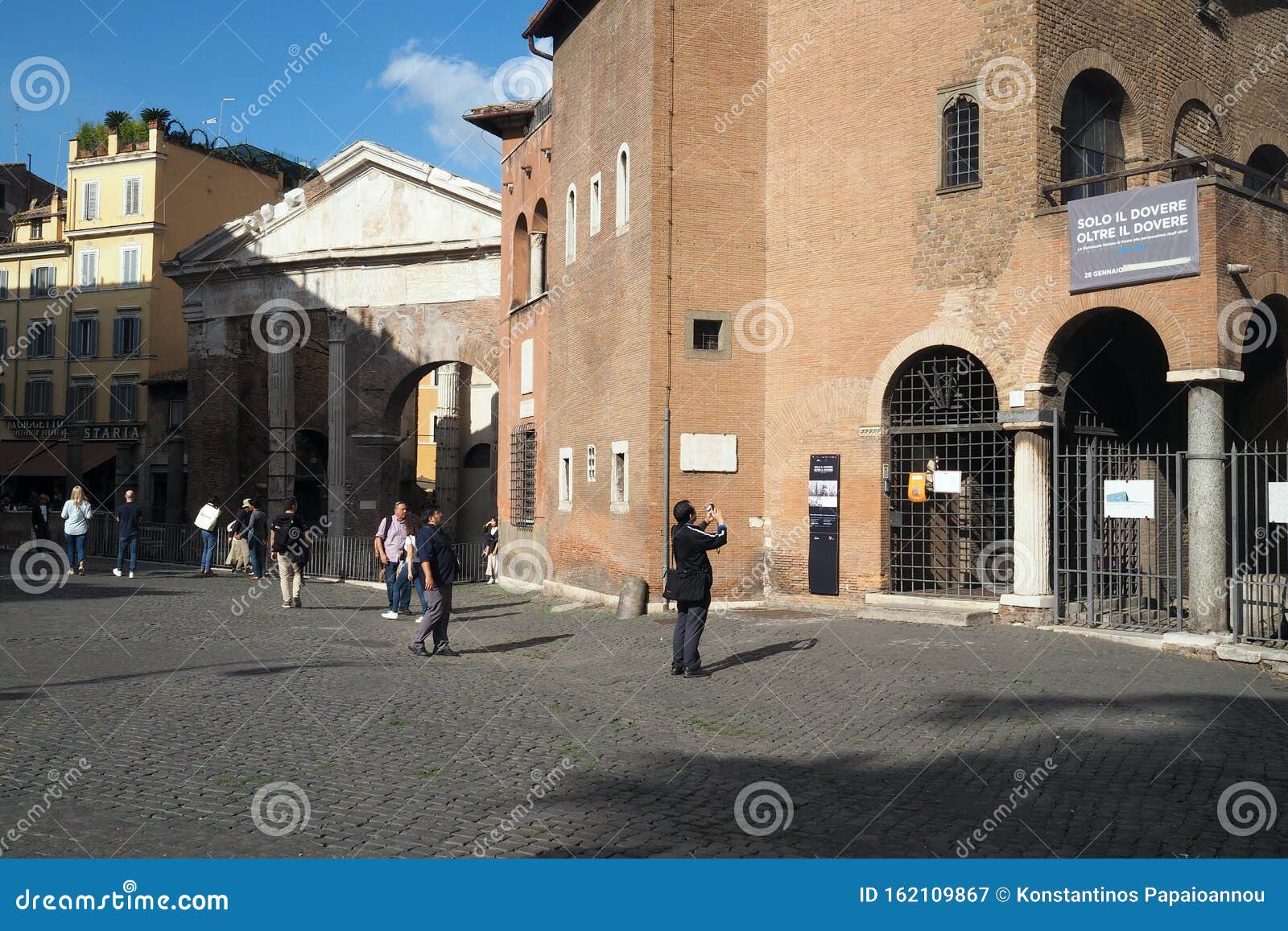
The entrance to the Museo dell’Ebraismo Italiano e della Shoah, at Casina dei Vallati in Rome’s historic Jewish ghetto. (Rossella Tercatin/ Times of Israel)
Under the leadership of museum president Mario Venezia, the institution has involved itself with a wide variety of projects, including filming documentaries, writing history books, producing theatrical performances, and hosting educational programs as well as courses for teachers nationwide.
The “From Italy to Auschwitz” exhibit seeks to tell the story of the deportation between 1943 and 1944 of more than 9,000 Jews from Italian territory — including the parts of Greece occupied by Italy — as well as about 1,000 non-Jews deported for political or other reasons.
Venezia says he made the decision to recruit volunteers, including Holocaust survivors, to engage with the public five years ago.
Emanuele Di Porto speaks about his experience in a Zoom conference. (Courtesy)
“We now have 26 trained volunteers who speak several languages — Italian, English, Hebrew and French — some of whom witnessed the racial laws and the Nazi-Fascist occupation of Italy,” he says. “Before the pandemic they would meet with young people at schools, but now their testimonials take place online. We want people to see real faces with real stories.”
The four volunteers who lived through the Holocaust in Italy spoke with The Times of Israel ahead of Holocaust Remembrance Day. These are their stories.
Silvana Ajò Cagli, 93
Silvana Ajò Cagli, left, was nine years old when she was expelled from school for being Jewish. (Courtesy)
Silvana Ajò Cagli, now 93 years old, was just 9 when she was expelled from her school in 1938 for being Jewish, despite earning excellent grades, she notes.
“I had finished the fifth year of primary school and had taken the exam for admission to high school, when overnight, we were expelled from school. A janitor told us,” Cagli recalls. “Put yourself in the shoes of a child who hasn’t the faintest idea of what’s going on and wonders ‘what did I do?’”
“The following year my sisters and I stayed at home while the other children went to school. From a psychological point of view, our families were devastated. We studied at home, the classmates and teachers phoned us and gave us homework to do,” Cagli says.
After Italy surrendered to the Allied forces on September 8, 1943, the Germans were quick to occupy Rome. On September 26, the commander of the local German police Herbert Kappler called the president of the Jewish community to his office and ordered him to deliver 50 kilograms (110 pounds) of gold within 36 hours or Kappler would deport 200 Jewish heads of household. The Nazi security officers told the leaders of the Jewish community that if they supplied the gold, no one would be harmed.
It was thought that the Germans, despite being enemies, would keep their word
“At the time it was thought that the Germans, despite being enemies, would keep their word,” says Cagli. “Many people, both friends strangers brought what they had at home and joined the line of people that had formed behind the Great Synagogue.”
Once the community had scraped together the payoff, the gold was brought to SD (the Sicherheitsdienst, SS or security police) headquarters.
“The Germans told us that we had nothing to fear because we had obeyed their orders,” says Cagli. “A few days later my father received a phone call from a friend who worked at the Ministry of the Interior, who said he was worried about us because of some rumors he had heard in the office. He advised us to warn our Jewish friends and get away from home.
Silvana Ajò Cagli, center in dark shirt, in her youth. (Courtesy)
“It was not an easy decision,” she says. “We had a shop in the center of town and so many problems to solve before fleeing. At the beginning of October we ran away after notifying all our relatives. My uncles, who lived in the city, didn’t flee and on October 16, 1943, the day of the roundup of the Rome ghetto, they disappeared into thin air.”
That day 1,259 people, including 689 women, 363 men and 207 children, were rounded up. Almost all of them belonged to the Jewish community. The raid was carried out by the Gestapo with help from fascist collaborators between 5:30 a.m. and 2 p.m. on Saturday, October 16, a day that became known as “Black Saturday.” It is no coincidence, Cagli says, that the Nazis chose to conduct the raid on the Jewish Day of Rest.
Two days after the raid 1,022 people, including a child born the previous day, were taken to Rome’s Tiburtina station and herded onto 28 cattle wagons unequipped with toilets. From there, they were deported to the Auschwitz extermination camp. Only 16 of them returned — 15 men and one woman.
“We were saved thanks to our friendships,” says Cagli. “Before the raid, a customer of the shop, a carabiniere [member of the military police], gave us the keys to his house, allowing us to hide there while he and his family were out of town. It was an act of great friendship and loyalty.
“I hid there with my mother and my sisters while my father and two cousins found refuge in one of the houses in the San Lorenzo neighborhood, bombed by the Allies during the war. Our friends brought us food because we couldn’t go out. We stayed there for nine months; my father came to visit us every day by bicycle,” she says.
Emanuele Di Porto, 89
Italian Holocaust survivor Emanuele Di Porto. (Courtesy)
89-year-old Emanuele Di Porto was 12 when the Nazis entered the Rome ghetto and arrested him along with his mother.
“My father traded souvenirs. He got up at 3 a.m. and went to the Termini railway station to sell items to German soldiers returning from the front,” Di Porto says. “On Saturday, October 16, he went out early in the morning. My brothers and I were alone at home. At 5:00 a.m. my mother heard noises, and looked out the window and saw the Nazis rounding people up in the streets of the ghetto. Thinking that the SS only wanted to capture the men, my mother went to my father at the railway station to warn him of what was happening.”
I was at the window and saw my mother being captured by a soldier and loaded onto a truck
Di Porto’s father told his wife to go home and take the children to her sister, who lived in another district. He would be waiting for them there.
“I was at the window and saw my mother being captured by a soldier and loaded onto a truck,” says Di Porto. “I started screaming and went out onto the street. My mother, seeing me arrive, motioned me to leave but the Germans took me and threw me on the truck. Somehow my mother managed to get me off, and I walked without turning around. I was dying of fear.”
Di Porto eventually reached a square with streetcars, and boarded one that circled the city. When he told the conductor that he was Jewish and the Germans had raided his house, the man sat him down next to him in the front of the car.
Emanuele Di Porto, standing, back center, as a child. (Courtesy)
“It was six in the morning and it was raining,” Di Porto says. “At 11:00 the driver gave me half of his snack. At 2:00 there was the shift change, and the controller told the colleague replacing him to ‘look after this kid.’ The colleague of the next shift did the same thing. So I stayed on the tram for two days, sleeping and eating in the carriage. In the morning, in the depot, the drivers noticed my presence but no one told me to leave.”
On the third day, an acquaintance of the Di Porto family who also lived in the ghetto got on the tram.
“He told me that my father was convinced I had been captured together with my mother,” Di Porto says. “At that moment my father was near San Pietro, in Vatican City. I joined him and found my relatives. From October 1943 to June 4, 1944, the day of Rome’s liberation, we stayed in our house in the ghetto without realizing the danger we were facing. My mother, deported to the Auschwitz-Birkenau concentration camp, was immediately killed in the gas chamber at the age of 37.”
Emanuele was saved twice, first by his mother and then by the staff of the tram company.
“My mother brought me into the world twice,” he says. “First when she gave birth to me and then when she got me off of that truck.”
Attilio Lattes, 79
Attilio Lattes had no idea about his harrowing escape as a toddler until he was in his 40s. (Courtesy)
Casina Vallati Rome
Attilio Lattes, 79, was born in Rome in 1941. At the time of his birth, his father, an air force major, had already lost his job due to the race laws. He’d returned to Italy after the country’s military intervention in the Spanish Civil War of 1936-1939 and gone to the Royal Ministry of War to receive further instructions. A colonel scornfully told him that since he was Jewish, he had no assignment.
Lattes’s mother had a shop on the Via del Corso, an important street in Rome’s city center. At the end of 1940 two fascists showed up at the door and told her that she had 48 hours to close the business or hand it over to an Aryan. His mother preferred to close the shop.
On the evening of Friday, October 15, the day before the raid on the ghetto, the two-year-old Lattes was with his family at his aunt’s house. The family received a phone call at 5:30 a.m. informing them that the Germans were arriving. His aunt, with her husband and children, quickly left the house.
This gentleman motioned to my father to cover my mouth with his hand and to remain silent
“We delayed perhaps because I, being a two-year-old child, made my parents late,” says Lattes. “The superintendent of the building, seeing my father, who in the meantime had gone down to the ground floor, prevented him from going out. ‘Major, where are you going? There are the Germans,’ he said. The super told him to go downstairs with me and my mother to a small, dark room where a waiting person would help us escape. This gentleman motioned to my father to cover my mouth with his hand and to remain silent.”
Four Nazis and a fascist Blackshirt arrived. One of them guarded the door of the building, and another stayed behind to watch the truck, on which they had loaded two families captured earlier. The others went up to Lattes’s aunt’s fourth-floor apartment. Meanwhile, the superintendent sneaked past the guard and crept downstairs, where he knocked on the door of the tiny room. This was the signal to begin the escape.
Attilio Lattes as a child, around the time of his harrowing escape from the Nazis.
“The man who told us to stay quiet in the closet told my father, ‘Get ready to pitch your son at me like he’s a ball,'” says Lattes. “On the wall was a framed poster depicting Benito Mussolini with Adolf Hitler, who was stepping on a snake with a stereotypical Jewish face. The man lifted the poster, revealing a hole in the wall and a trap door. It had probably been used before by other people — perhaps opponents of the regime — to escape.”
The stranger who was helping the Lattes family climbed down first, then Lattes’s father tossed him down into the man’s arms.
“We had reached the sewers, three meters [10 feet] underground,” says Lattes. “Walking and crawling for two hours, on all fours and against the current, we followed the man who was guiding us through the tunnels of the sewer system, among excrement, dead animals and even pieces of dead bodies.”
They emerged out onto the slope of Monte Mario, a hill in the city’s northwest that at the time was covered with trees. They hid there among the thicket until the following morning, when Lattes’s father finally decided it was safe enough to venture out. They went to the home of some Catholic friends who welcomed them in.
“We washed and refreshed ourselves, and stayed there for 10 days. We ended up hiding in seven different flats. In January 1944 we took refuge in two convents until June 4, the day of the liberation of the capital,” Lattes says.
I only became aware of it in 1983, just 20 days before my father died
Lattes was too young when this story took place to remember it himself.
“I only became aware of it in 1983, just 20 days before my father died,” he says. “When I asked him why he had kept it from me for so many years, he replied that I couldn’t understand what he and my mother had been through in those moments. The trauma had been devastating.”
Marco Di Porto, 79
Holocaust survivor Marco Di Porto, now a historian, hid in a convent for 9 months as a child to escape the Nazis. (Courtesy)
Casino Of Vallati Jobs
Marco Di Porto (no relation to Emanuele Di Porto) is 79 years old and still working as a sales agent and historian. His parents, after losing their jobs due to the race laws, were married in June 1939. Di Porto’s mother devoted herself to the family; his father found another job as a traveling salesman in Lombardy.
Casino Of Vallati Thunder
“When she became pregnant, my mother had to give birth at home because when she went to San Camillo hospital in Rome she was thrown out for being Jewish,” says Di Porto. “Jews could not be treated by ‘Aryan’ doctors. When I was born my mother was helped by a Jewish midwife. This is an episode that I always tell the kids when I go to schools.”
In 1941 and early 1942, conditions worsened further for Italian Jews. One of the laws signed by Mussolini consigned Jewish men between 18 and 55 to forced labor.
One of the laws signed by Mussolini consigned Jewish men between 18 and 55 to forced labor
“My father, like so many other coreligionists, was forced to go to the banks of the Tiber River to shovel the sand that accumulated when the water overflowed,” Di Porto says. “Obviously the work was unpaid. There was widespread concern that compulsory labor was the antechamber of the concentration camps.”
According to Di Porto, when the Jewish community of Rome managed to collect the 50 kilos of gold demanded by the Nazis in late September of 1943, they thought they had bought themselves safety.
“Two weeks later, on October 16, 1943, the day of the Rome raid, my father hid in a convent in the city,” says Di Porto. “I stayed at home, in the Monteverde Vecchio district, with other relatives. My mother left the house very early, at 5:30, to go shopping.
Holocaust survivor Marco Di Porto as a child with his mother. (Courtesy)
“A neighbor warned us of the imminent arrival of the Germans,” he says. “My aunt and her sisters wrapped me in a blanket and fled to a church not far from our home. The parish priest saw three girls arrive with a small child in their arms. My aunts introduced themselves as Jewish and said the Nazis wanted to take them away. The priest immediately opened the door and let them in.”
Later, Di Porto was joined by his mother and grandmother. They slept in the cellar and the next morning the parish priest had to reluctantly send them away because he had nothing for them to eat.
“My mother decided to take a bus to the Termini railway station. It was a big risk, but we arrived at the Church of the Sacred Heart,” Di Porto says. “Years later I went back there and managed to consult the diary of the pastor of the time, who had noted on October 17, 1943, the arrival of a Jewish family consisting of five women and a child named Marco Di Porto.
“On the morning of October 18, while the train with 1,022 Jews bound for Auschwitz was leaving from Tiburtina, the parish priest warned us that we could no longer stay. My mother was desperate, but the priest told her to go to the Trastevere district, where there was a convent in which the Jews took refuge.”
In the convent they found 150 other Jews
The mother superior opened the door and let them in without asking who they were or why they were there. In the convent they found 150 other Jews.
Casino Of Vallati Characters
“One day the fascists came, but the nuns lined up in front of the entrance saying that if they wanted to get inside they would have to arrest them first. They didn’t enter,” Di Porto says.
Casino Of Vallati Numbers
“We remained in hiding from October 18, 1943 to June 4, 1944, when Rome was liberated. Many years later I returned to this convent, finding the same places where I lived for nine months, and it was exciting. I was moved and I cried,” says Di Porto.