
Isaacs Archive | Trotskyist Writers Index | ETOL Main Page
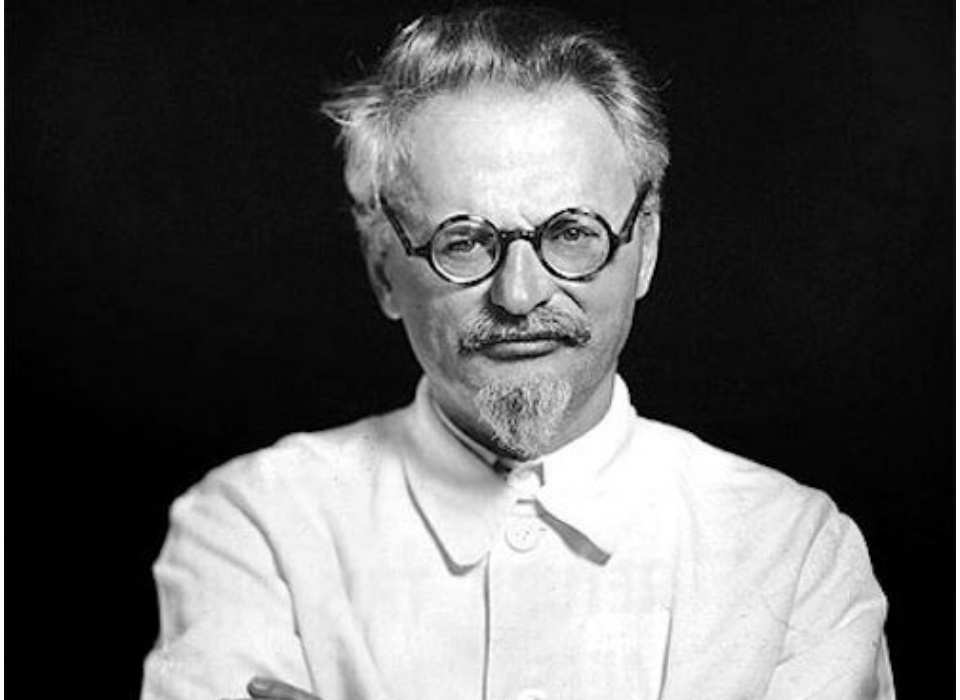
Leon Trotsky, the exiled Bolshevik leader, died early this morning from injuries received when he was attacked in his home in a suburb of Mexico City some thirty hours earlier. Abstract LEON TROTSKY WAS one of the founders of the Soviet Union and an obvious candidate to replace Lenin after his death. Unfortunately for him, it was Joseph Stalin who came to power, and Trotsky went into a long forced exile that eventually took him to Mexico, where he found asylum. Similar delay is occurring in the case of “Frank Jacson,” the GPU assassin who succeeded In striking the death-blow on August 20, 1940. Trotsky’s article gives us his own description of the May 24th attempt on his life and of the events of the next two weeks. Ramon Mercader, an undercover agent for the Soviet Union's secret police, attacked Trotsky with a mountaineering ice ax, puncturing his skull. He was taken to the hospital, but died a day later, at.
George Stern
(7 September 1940)
From Socialist Appeal, Vol. 4 No. 36, 7 September 1940, p. 3.
Transcribed & marked up by Einde O’Callaghan for the Encyclopaedia of Trotskyism On-Line (ETOL).
In life Leon Trotsky was always a feared and fearful figure to the capitalist press of the world. In death he is still the hated symbol of the workers’ revolution. Upon his still and silenced figure the newspapers continue their vituperative assaults.
They know that while Trotsky is dead, Trotskyism is still the specter that haunts their halls of power. They tried to splatter his name while he lived. They still have the job of muddying his memory now that he is dead.
From their obituary biographies emerges a fantastic caricature of a man with a “checkered career”, as the saying goes, an adventurer, a fallen Napoleon, a would-be Genghiz Khan, a wandering Jew on the face of a planet he defiled. From the limited bounds of their vision they could not, after all, be expected to perceive the figure of Trotsky, the revolutionary titan. The venom of their final curses over his dead body revealed only their instinctive sense of Trotsky as an enemy, a powerful and fearful enemy of the social order they themselves defend.
Where more serious biographical attempts were made, as in the New York Times, a combination of Stalinist and bourgeois distortions were arbitrarily grafted upon a slim framework of the actual physical facts of his life. The Times, intent up reducing this gigantic historical figure to the puny dimensions of the men it better understands, resurrected the charge that Trotsky was “jealous of Lenin’s power and discontented with the fact that he did not have an equal share in controlling Russia’s destinies.” Also out of its grab bag of handy lies, the Times pulled the assertion that in 1926 Trotsky “capitulated unconditionally (to Stalin) and publicly repudiated his action.”
The New York Daily News saw Trotsky as “the greatest, slyest plotter of the Russian pre-revolution, a devious thinker who outwitted everyone save Stalin after the Revolution.”
Trotsky Death Ice Pick
The Deliberate Line of Their Editorials
Editorial comment on the murder of Trotsky varied on two themes: first, Trotsky was a victim of a system he himself helped to create; second, Trotsky’s life work flowered in Hitler, Stalin, and Mussolini.
The American workers are to be persuaded, you see, that the murderous regime of Stalin is the natural outgrowth – and not the debased and twisted degeneration – of the workers’ revolution which Lenin and Trotsky led to victory. The world revolution for which they fought, our master newspapers tell us, is now actually being realized ... by Hitler and Mussolini.
On the first of these two themes, both the New York Times and the New York Herald-Tribune, played. The Tribune (Aug. 23) said that Trotsky “trampled ruthlessly over millions ... and was trampled as ruthlessly himself ... meeting an end only too characteristic of the age which he had done so much to produce.”
Said the Times (Aug. 23:
“The long arm of Stalin’s Ogpu ... finally completed the job with a blow into Trotsky’s skull. Brutal? Of course it was; but it was no more brutal than the Stalin tyranny as a whole, no more ruthless than the Russian revolution which this consummate firebrand in exile had himself set alight and kept aflame a generation ago ... The victims of his cold cruelty, and of Lenin’s, can be numbered in the millions; the wastes of Siberia are bleached with their bones. It was not enough for him that Russia should be drenched in blood and suffering; the whole world had to wade through a sea of violence so that the triumph of the proletariat could be assured.”
They Dare to Speak of Violence!
How calmly and easily these newspaper hacks indict the Russian revolution and its leaders for the violence that, shook the world after 1914! The reprehensible violence was not the violence of the First World War, outcome of capitalist greed and rivalry, which took the lives of 20 million men, women and children, and twisted the lives of scores of millions more! Oh no, it was the force wielded by workers who rose in revolt against this senseless slaughter and established their own power as the forerunners of a world socialist order. This was their crime. This was Trotsky’s crime.
The armed support giving by France, Britain, and the United States to the White Russian armies after 1918, the invasion of Russia by French, British, American and Japanese troops did not constitute anything resembling “cold cruelty.” That term the newspaper hacks reserve for the defense of the Russian workers, led by Lenin and Trotsky.
The capitalist order then, as now, is indeed forcing the peoples of the world to “wade through a sea of violence.” It was the effort of Lenin and Trotsky then and it is our effort today to lead them out of that bloodied sea onto a far shore of a new kind of peace, a socialist peace. These capitalist choir boys who write these bland editorials in their newspapers are quite content to see these millions drown in their own blood as long as their deaths can keep the worm-eaten hull of the capitalist order afloat. Is it not the Tribune which has openly called upon the United States to declare war on Germany? Is it not the Times today that is in the forefront of that band of boss warmongers dragging the American people closer every day into the present-day “sea of violence”?
Evils of Capitalism Laid at Trotsky’s Door!
But they have a way of making Lenin and Trotsky responsible for today’s slaughters as well as two decades ago. Isn’t it part of the threshing agonies of a dying capitalist order festering with a sore call[ed] Fascism? Nothing of the kind, according to the N.Y. Herald-Tribune. It’s all due to ... Trotsky.
“For his monument (said the Tribune editorial), one need only look about one ... Trotsky is dead and Trotskyism rules in Berlin and Moscow and Rome; it roars through the propaganda ministries’ loudspeakers, loads the bomb racks, fuels the tank columns, infuses the ‘fifth columns’ with their heartless fanatism ...”
Trotsky was often in his life the victim of amalgams – false couplings with his enemies and opponents, unscrupulously manufactured in attempts to destroy his influence over the workers. He and Lenin together were smeared in 1917 as “agents of the Kaiser.” Trotsky was smeared by Stalin as an agent first of the British, then of Hitler, then of the British again and now of the United States! The Tribune simply adopts this mechanism for the benefit of its own purposes, and seeks to bracket Trotsky simultaneously in the minds of the American people with Stalin, with Hitler, and with Mussolini.
Abyss Between Stalinism and Trotskyism
Trotsky Death Place
But between Trotsky and Stalin, history itself has dug an abyss. Stalin embodied in his person and his regime the degeneration of the Russian Revolution. This degeneration flowed from the isolation of the Soviet Union and its backwardness in the midst of a hostile capitalist world. Trotsky was the living embodiment of the revolution itself, who fought to make it and then fought to extend it because he understood that socialism could triumph only as a world order. This brought him into irreconcilable struggle against Stalinism as well as against the whole of the capitalist world. Of the. disorders of this capitalist world, Hitler and Mussolini are only two additional and especially virulent manifestations. They represent the hypodermic injection of Fascism with which capitalism is trying to prolong its last hours. In the revolution that will again raise Trotsky’s banner aloft, Hitler and Mussolini will be among the first to fall.
Trotsky’s life as a man of action, as a revolutionist, was indeed a life filled with violence – but it was violence employed against those who make violence the very basis of their whole system of society, employed against the capitalist rulers of the world who govern by gun and club and bomb. Our masters and their journalistic acolytes glorify the violence that bolsters their own way of life. They shudder – and rightly – at the violence which challenges that way of life. Of that challenge Trotsky was a mighty symbol. That is why they hated him so while he lived. That is why they still fear and hate him even now that he is dead.

Top of page
Isaacs Archive | Trotskyist Writers Index | ETOL Main Page
Last updated: 16 August 2020
Today marks the anniversary of Leon Trotsky’s assassination. Struck down 78 years ago by an ice-pick to the head from a cowardly Stalinist assassin, he soon fell into a coma and died the following day, 21st August 1940. Here we republish an article from the anniversary in 2012, the fight for Trotsky's ideas remain as relevant as ever and we commemorate the life and ideas of this inspiring revolutionary, theoretician and leader.
The attack was no surprise. Ever since Trotsky’s arrival in Mexico, the Stalinist press was busy slandering the Old Man in preparation for an assassination attempt. At the same time, Moscow was waging a massive international campaign against him, infiltrating the movement and, under Stalin’s orders, preparing his death.
Following the end of the Spanish Civil War, Stalinist NKVD agents were dispatched to Mexico to carry out the plans. The first assault had come in May 1940, when Trotsky’s bedroom was riddled with bullets and Robert Sheldon Harte, his secretary-guard, was kidnapped and murdered. Sheldon’s body was later discovered in a lime-pit. Stalin had become desperate in his efforts to eliminate Trotsky, one of the few old Bolsheviks still alive - the rest had been murdered by Stalin during the Purge Trials of 1936-38. These horrendous frame-ups, where the defendants were forced to implicate themselves in lies and terrorist crimes supposedly organized by Trotsky, constituted a river of blood differentiating counter-revolutionary Stalinism from genuine Bolshevism.
Stalin knew that having betrayed the Revolution, he needed to eliminate those who defended and embodied the ideas of Bolshevism and world revolution. First and foremost this fell to Leon Trotsky, who had been driven into exile some eleven years earlier. All the resources of the Russian state were now set in motion to carry out his assassination. Before long, Stalin had murdered several of Trotsky’s co-workers, seven of his secretaries, and four of his children – the latest being his son Leon Sedov in early 1938.
Trotsky was an outstanding revolutionary and theoretician. As early as 1904, he expounded this theory of the Permanent Revolution, which was confirmed in practice by the October Revolution. Trotsky had spent his entire life in the revolutionary movement, led the Petrograd Soviet in 1905, led with Lenin the October Revolution in 1917, created the Red Army from scratch, helped build the Third International, then, fighting against the Stalinist bureaucracy, was cast from power and forced into exile by Stalin.
From Alma Ata, while others capitulated to Stalin, he single-handedly took up the struggle to build the International Left Opposition in the fight for genuine Marxism. He analysed Stalinism as a form of Bonapartism, but based upon a nationalized planned economy. Stalinism was a Thermidorian reaction that arose from the isolation of the Russian Revolution in a backward country, resulting in a massive growth of the bureaucracy in the party and state. Stalin was the figure head of this political reaction to October, who sought to trample over the real heritage of October and pursue the anti-Marxist idea of “Socialism in One Country”.
The struggle between the International Left Opposition and Stalinism was a fight to the death, in the most literal sense. During the Purges of the 1930s, 18 million were arrested on trumped up charges (“enemies of the people”) and sent to labour camps in hostile and extreme environments, out of which some five million would perish, either of starvation, disease or firing squad. Within two years of the 1934 seventh party congress, out of 139 members elected to the central committee, 110 had been arrested. The Red Army was decimated: 13 out of the 19 commanders of the army corps, 110 out of 135 commanders of divisions and brigades, half of the commanders of regiments and most of the political commissars were executed. In 1938, the Polish Communist Party was officially dissolved on the pretext that it was a cover for counterespionage!
“Our old comrade of the Polish party, Schwarzbart, one of the secretaries of the autonomous Jewish district of Birobidzhan, went before the public prosecutors”, recalled Leopold Trepper, the former leader of the Communists working behind enemy lines (the “Red Orchestra”). “He was thrown into prison, where he became almost blind. One morning at dawn he was taken out into the yard and placed before a firing squad. Before he died, he shouted his faith in the revolution, and just as the bullets laid this old communist militant in the dust, from the cells rose the powerful strains of the Internationale.”
Trepper says that “all those who did not rise up against the Stalinist machine are responsible, collectively responsible. I am no exception to this verdict.”
However, he goes on:
“But who did protest at the time? Who rose up to voice his outrage?
“The Trotskyists can lay claim to this honor. Following the example of their leader, who was rewarded for his obstinacy with the end of an ice-pick, they fought Stalinism to the death, and they were the only ones who did. By the time of the great purges, they could only shout their rebellion in the freezing wastelands where they had been dragged in order to be exterminated. In the camps, their conduct was admirable. But their voices were lost in the tundra.
“Today, the Trotskyists have a right to accuse those who once howled along with the wolves. Let them not forget, however, that they had an enormous advantage over us of having a coherent political system capable of replacing Stalinism. They had something to cling to in the midst of their profound distress at seeing the Revolution betrayed. They did not “confess”, for they knew that their confession would serve neither the party nor socialism.” (The Great Game, pp.55-56)
As Trotsky had explained in January 1937, with the announcement of new trials of Radek, Pyatakov and others, “How could these Old Bolsheviks, who went through the jails and exiles of Tsarism, who were the heroes of the civil war, the leaders of industry, the builders of the party, diplomats, turn out at the moment of the ‘the complete victory of socialism’ to be saboteurs, allies of fascism, organisers of espionage, agents of capitalist restoration? Who can believe such accusations? How can anyone be made to believe them? And why is Stalin compelled to tie up the fate of his personal rule with these monstrous, impossible, nightmarish juridical trials?
“First and foremost, I must affirm the conclusion I had previously drawn that the top rulers feel themselves more and more shaky. The degree of repression is always in proportion to the magnitude of the danger. The omnipotence of the Soviet bureaucracy, its privileges, its lavish mode of life, are not cloaked by any tradition, any ideology, any legal forms. The Soviet bureaucracy is a caste of upstarts trembling for their power, for their revenues, standing in fear of the masses, and ready to punish by fire and sword not only every attempt upon their rights but even the slightest doubt of their infallibility. Stalin is the embodiment of these feelings and moods of the ruling caste: therein lies his strength and his weakness.” (Writings, 1936-37, p.121)
He went on to describe the Moscow frame-ups as “the greatest political crime of our epoch and, perhaps, of all epochs.”
In Mexico, in 1937, an independent International Committee of Inquiry was established to examine the Moscow Trials. This inquiry examined all the documents, allegations and evidence, including those from Trotsky. After a rigorous examination of the facts, the Committee declared that the Moscow Trials were a frame-up and that Trotsky and his son were innocent of the charges made against them.
Trotsky was driven from one country to another, where governments closed their doors to him. Only in republican Mexico did he find refuge, and then only to be encircled by hostile agents, trained to do Stalin’s bidding. From here, Trotsky worked continuously to rebuild the forces of genuine Marxism. From here, he laid the basis for a new International.
In August 1936, after completing his brilliant analysis of Stalinism in “The Revolution Betrayed”, and the opening of the frame-up trial of Zinoviev and Kamenev, Trotsky wrote the following about the need to preserve our heritage:
“Reactionary epochs like our own not only disintegrate and weaken the working class and its vanguard but also lower the general ideological level of the movement and throw political thinking back to stages long since passed through. In these conditions, the task of the vanguard is above all not to let itself be carried along by the backward flow: it must swim against the current. If an unfavourable relation of forces prevents it from holding the positions that it has won, it must at least retain its ideological positions, because in them is expressed the dearly purchased experience of the past. Fools will consider this policy ‘sectarian’. Actually it is the only means of preparing for a new tremendous surge forward with the coming tide.
“Great political defeats inevitably provoke a reconsideration of values, generally occurring in two directions. On the one hand the true vanguard, enriched by the experience of defeat, defends with tooth and nail the heritage of revolutionary thought and on this basis attempts to educate new cadres for the mass struggles to come. On the other hand the routinists, centrists, and dilettantes, frightened by defeat, do their best to destroy the authority of revolutionary tradition and go backward in their search for a ‘New Word’.” (Trotsky, Stalinism and Bolshevism)
Trotsky Death In Mexico
Trotsky’s struggle was clearly a defence of our revolutionary heritage. Fighting against the stream, he consciously educated and prepared a new cadre for the future revolution. All his time and energy was devoted to this fundamental aim. With the complete degeneration of the Second reformist International and the Stalinist Comintern, the issue of constructing a new international, under extreme difficulties, was paramount. For Trotsky, it was a race against time.
In his Diary in Exile, written in 1935, he explained: “And still I think that the work I am engaged now, despite its extremely insufficient and fragmentary nature, is the most important work of my life – more important than 1917, more important than the period of the Civil War or any other…
“Thus I cannot speak of the ‘indispensability’ of my work, even about the period from 1917 to 1921. But now my work is ‘indispensable’ in the full sense of the word. There is no arrogance in this claim at all. The collapse of the two Internationals has posed a problem which none of the leaders of these Internationals is at all equipped to solve. The vicissitudes of my personal fate have confronted me with this problem and armed me with important experience in dealing with it. There is now no one except me to carry out the mission of arming a new generation with the revolutionary method over the heads of the leaders of the Second and Third International. And I am in a complete agreement with Lenin (or rather Turgenev) that the worse vice is to be more than 55 years old! I need at least about five more years of uninterrupted work to ensure the succession.”
Trotsky had only five more years to live before his murder. He was fully aware of Stalin’s intentions to eliminate him. Stalin had very much regretted the decision to deport him out of reach. These last years were crammed full of articles, letters and advice to the young forces of Trotskyism, as well as the founding of the Fourth International. These were the richest of years as can be seen from his invaluable writings.
Following Trotsky’s tragic death, the Fourth International was destroyed by its inadequate leadership, who made one mistake after another and was consumed with prestige politics. As with Marx, Trotsky had sown dragons but reaped fleas. Nevertheless, the task remains to rebuild the movement, which is being undertaken today by the International Marxist Tendency. Based on the real ideas of Trotsky and the great Marxists, we will finish the task bequeathed by the Old Man.
Who Killed Trotsky
On this occasion of the anniversary of Trotsky’s assassination, we renew our faith in the world working class and the revolutionaries ideas of Marxism. World revolution is now being put back on the agenda. We are therefore proud to stand on the shoulders of giants. We hold to the words of Trotsky’s final Testament:
Trotsky Death Date
'I can see the bright green strip of grass beneath the wall, and the clear blue sky above the wall, and sunlight everywhere. Life is beautiful. Let the future generations cleanse it of all evil, oppression and vileness and enjoy it to the full.”